
Is a Certificate IV the Same Level as a Degree or Graduate Qualification?
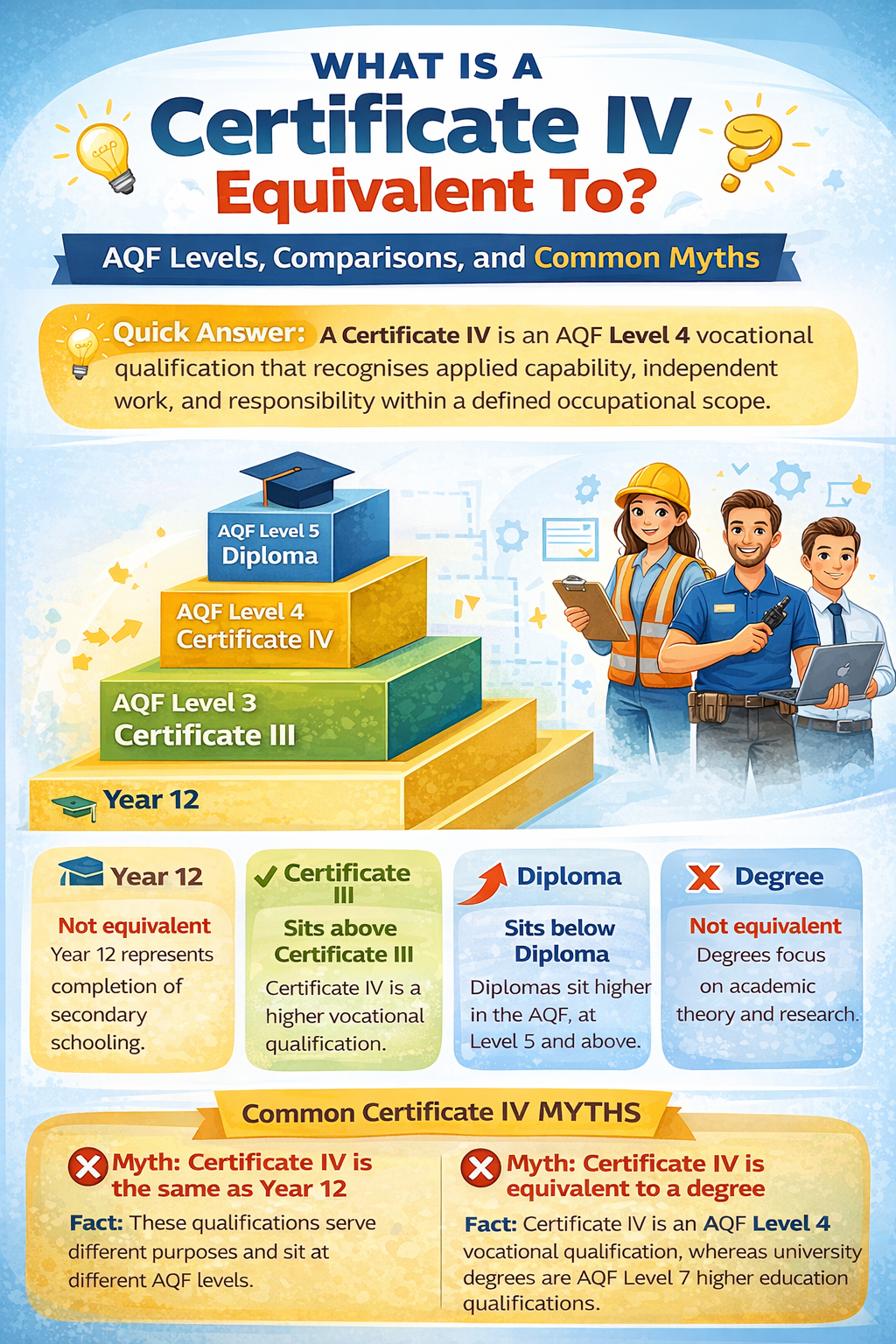
Quick Answer: A Certificate IV is an AQF Level 4 vocational qualification that recognises applied capability, independent work, and responsibility within a defined occupational scope.
Within the Australian Qualifications Framework, Certificate IV sits above Certificate III and below Diploma qualifications, forming part of the vocational education and training pathway rather than the university degree pathway.
It is not equivalent to Year 12, although it sits above it in the national qualification hierarchy. Year 12 confirms completion of secondary schooling, while a Certificate IV confirms that a person can apply skills and judgement in a specific occupational area.
It is also not equivalent to a bachelor’s degree or graduate qualification, which operate at higher AQF levels and emphasise academic theory and research.
In most industries, Certificate IV aligns with team leaders, supervisors, and experienced operational staff responsible for coordinating work, maintaining standards, and supporting organisational performance.
For example, the
Certificate IV in Leadership and Management (BSB40520)
prepares professionals to supervise teams, coordinate operational activities, and contribute to workplace performance.
At Vanguard Business Education, programs are delivered through an
Applied Capability Education
approach that focuses on demonstrated workplace capability rather than passive knowledge acquisition.
Certificate IV Guide Overview
What This Guide Covers
Questions about Certificate IV equivalence are common because the qualification sits between entry level vocational training and higher vocational education.
People often try to understand its value by comparing it with other qualifications. The most common comparisons involve:
• Year 12
• Certificate III
• Diploma qualifications
• university degrees
These comparisons can create confusion because each qualification serves a different purpose within the Australian Qualifications Framework. School completion confirms general education. Vocational qualifications confirm applied occupational capability. University degrees emphasise academic knowledge and theory.
This guide explains how Certificate IV fits within the Australian Qualifications Framework (AQF) and what level of responsibility the qualification is designed to support in real workplaces.
The sections that follow clarify several areas that are frequently misunderstood, including:
• what AQF Level 4 actually represents
• whether Certificate IV is equivalent to Year 12
• the difference between Certificate III and Certificate IV capability
• how Certificate IV compares with Diploma qualifications
• whether Certificate IV is comparable to university degrees
• how employers interpret Certificate IV credentials when assessing supervisory or leadership capability
The objective is to provide a clear explanation of qualification level, scope, and workplace alignment so readers can determine whether a Certificate IV matches their current or intended professional responsibilities.
For readers exploring supervisory pathways, the
Certificate IV in Leadership and Management (BSB40520)
is one of the most widely recognised qualifications used to develop frontline leadership and operational coordination capability.
At Vanguard Business Education, the qualification is delivered through an
Applied Capability Education
model that emphasises demonstrated workplace capability rather than passive theoretical learning.
Understanding AQF Level 4
Certificate IV sits at Level 4 within the Australian Qualifications Framework (AQF), the national system used in Australia to classify and compare education and training qualifications across schools, vocational education, and universities.
AQF Level 4 qualifications recognise individuals who can apply specialised knowledge and practical capability within a defined occupational area. The emphasis is on applied competence in real work environments rather than academic theory.
People operating at this level are expected to demonstrate the ability to:
• work independently within established organisational procedures
• apply specialised knowledge within a defined vocational field
• solve operational problems using judgement and experience
• coordinate the work of others in certain roles
The focus is on practical workplace application. While theoretical understanding may support the learning process, the qualification primarily confirms that a person can perform effectively within real operational contexts.
Professionals functioning at AQF Level 4 are often responsible for maintaining standards, coordinating tasks, and supporting team performance. They typically operate between frontline staff and higher level management, translating organisational expectations into daily work activities.
Roles commonly associated with Certificate IV capability include:
• team leader
• supervisor
• senior technician
• operations coordinator
• project support specialist
In vocational education, assessment at this level focuses on demonstrating capability under realistic workplace conditions. Learners may complete practical tasks, workplace projects, scenario based activities, or supervised demonstrations that confirm their ability to apply skills in operational situations.
This approach differs from many academic pathways, where evaluation often relies heavily on written examinations and theoretical analysis.
A deeper explanation of the qualification level and capability expectations can be found in the related article:
AQF Level 4 Explained: What a Certificate IV Actually Represents
Is a Certificate IV Equivalent to Year 12 or Higher?
A Certificate IV is not the same qualification as Year 12, although it sits above Year 12 within the Australian Qualifications Framework hierarchy.
Year 12 represents the completion of secondary school education. It provides a broad academic foundation across subjects such as English, mathematics, science, and humanities. The purpose of Year 12 is to confirm general education and prepare students for further study, training, or entry level employment.
A Certificate IV serves a different purpose. It represents vocational capability within a specific occupational field and confirms that a person can apply knowledge and skills in practical work situations.
The distinction is straightforward.
Year 12 confirms school completion.
Certificate IV confirms demonstrated capability within a profession or vocational discipline.
For example, a Year 12 graduate has completed secondary education across several academic subjects and may use the qualification to apply for university or vocational training.
A Certificate IV graduate has demonstrated the ability to perform responsibilities within a defined workplace scope. This might include coordinating tasks, applying specialised procedures, supporting operational performance, or supervising aspects of team activity depending on the qualification area.
Because of this difference in purpose, vocational qualifications are often undertaken after school or during employment. In many cases the training formalises capability that individuals are already applying in the workplace, allowing their experience to be recognised through a nationally recognised credential.
Within the AQF structure, the Certificate IV level reflects a higher qualification level than school completion, but it should not be interpreted as a direct academic equivalent. The two credentials represent different education pathways with different objectives.
Read the Detailed Certificate IV vs Year 12 Comparison
Certificate III vs Certificate IV: Responsibility and Capability
Certificate III and Certificate IV represent different levels of vocational capability and workplace responsibility within the Australian Qualifications Framework.
A Certificate III typically recognises workers who perform skilled operational tasks within established procedures. Individuals at this level apply practical skills and follow defined processes to complete their work effectively.
These roles usually operate under structured supervision, with responsibilities that are clearly defined and limited to specific job functions. The focus is on performing tasks competently and consistently rather than managing broader operational outcomes.
Examples of roles commonly aligned with Certificate III capability include skilled operators, administrative staff, technicians, and trade assistants who contribute to day to day workplace activities.
Certificate IV represents a step forward in both independence and responsibility.
Professionals operating at this level may be expected to:
• solve operational problems
• coordinate team activities
• supervise staff
• adapt procedures to changing workplace requirements
Rather than simply performing tasks, individuals with Certificate IV capability often support the coordination and quality of work performed by others. They may act as a bridge between frontline staff and management, helping translate organisational standards into practical workplace activity.
The key distinction between the two qualifications lies in scope of responsibility, not merely the perceived difficulty of the training.
Certificate III aligns with competent operational work, where the primary focus is completing tasks according to established procedures.
Certificate IV aligns with advanced operators, supervisors, and experienced staff who contribute to maintaining outcomes, coordinating work processes, and supporting team performance.
Understanding this distinction helps individuals and employers determine which qualification level best matches a person’s current role or the level of responsibility they are preparing to undertake.
Compare Certificate III, Certificate IV and Diploma Pathways
Certificate IV vs Diploma: Scope and Responsibility
Certificate IV and Diploma qualifications sit at adjacent levels within vocational education, but they represent different levels of organisational responsibility and influence.
A Certificate IV focuses on operational capability and frontline leadership responsibilities. Individuals operating at this level are typically responsible for maintaining performance within established systems and procedures.
Common responsibilities associated with Certificate IV capability include:
• supervising staff
• coordinating operational work
• implementing established procedures
• maintaining performance standards
These roles are usually positioned close to day to day workplace activity. Team leaders, supervisors, and senior operational staff often hold Certificate IV level capability because their primary focus is ensuring work is completed effectively and consistently.
Diploma qualifications extend beyond operational coordination into planning, resource management, and broader organisational responsibility.
At this level, individuals may take responsibility for:
• planning organisational processes
• managing resources or budgets
• overseeing larger teams
• contributing to strategic decision making
Diploma level roles frequently involve interpreting organisational objectives and translating them into operational plans. Rather than focusing solely on team supervision, these positions often require managing projects, allocating resources, and coordinating multiple areas of activity.
The distinction between the two qualifications is therefore breadth of responsibility and organisational impact.
Certificate IV supports frontline leadership capability, where the emphasis is on supervising teams and maintaining operational performance.
Diploma qualifications support higher level management responsibility, where the focus shifts toward planning, resource allocation, and broader decision making that influences organisational outcomes.
Explore the Certificate IV vs Diploma Leadership Comparison
Certificate IV vs Diploma: Depth, Responsibility, and Career Impact Compared
Certificate IV and Diploma qualifications sit at adjacent levels within vocational education, but they represent different levels of organisational responsibility and influence.
A Certificate IV focuses on operational capability and frontline leadership responsibilities. Individuals operating at this level are typically responsible for maintaining performance within established systems and procedures.
Common responsibilities associated with Certificate IV capability include:
• supervising staff
• coordinating operational work
• implementing established procedures
• maintaining performance standards
These roles are usually positioned close to day to day workplace activity. Team leaders, supervisors, and senior operational staff often hold Certificate IV level capability because their primary focus is ensuring work is completed effectively and consistently.
Diploma qualifications extend beyond operational coordination into planning, resource management, and broader organisational responsibility.
At this level, individuals may take responsibility for:
• planning organisational processes
• managing resources or budgets
• overseeing larger teams
• contributing to strategic decision making
Diploma level roles frequently involve interpreting organisational objectives and translating them into operational plans. Rather than focusing solely on team supervision, these positions often require managing projects, allocating resources, and coordinating multiple areas of activity.
The distinction between the two qualifications is therefore breadth of responsibility and organisational impact.
Certificate IV supports frontline leadership capability, where the emphasis is on supervising teams and maintaining operational performance.
Diploma qualifications support higher level management responsibility, where the focus shifts toward planning, resource allocation, and broader decision making that influences organisational outcomes.
Certificate IV vs Diploma: Depth, Responsibility, and Career Impact Compared
Is Certificate IV the Same Level as a Degree?
A Certificate IV is not equivalent to a university degree or graduate qualification. The qualifications belong to different educational pathways and are designed to serve different purposes within the Australian education system.
A Certificate IV is a vocational qualification positioned at AQF Level 4. Its primary purpose is to confirm that a person can apply skills and knowledge within a specific occupational context. Training at this level focuses on practical workplace capability, operational judgement, and the ability to perform responsibilities within a defined professional scope.
Key characteristics of Certificate IV include:
• vocational qualification
• applied occupational capability
• AQF Level 4
In contrast, bachelor’s degrees belong to the higher education pathway and operate at AQF Level 7. University qualifications typically emphasise academic frameworks, theoretical understanding, research methods, and analytical thinking within a particular discipline.
Characteristics commonly associated with bachelor’s degrees include:
• academic qualifications
• theoretical and analytical frameworks
• AQF Level 7
The difference between the two pathways is largely related to educational purpose and learning approach.
Vocational education is designed to develop practical capability for specific occupations. Training is typically aligned with workplace tasks, industry standards, and real operational responsibilities.
University education focuses more heavily on discipline based knowledge, conceptual frameworks, and research capability. Graduates often apply this theoretical foundation within professional fields such as business, engineering, health, or law.
Because of these structural differences, the two qualifications are not directly comparable, even though both contribute to professional development and career progression in different ways.
Is a Certificate IV the Same Level as a Degree or Graduate Qualification?
Do Employers Value a Certificate IV?
Employers often value a Certificate IV when the qualification reflects capability that is directly relevant to the responsibilities of the role. In many industries, it signals that an individual has undertaken structured training in areas that support operational leadership and workplace coordination.
A Certificate IV can indicate competence in areas such as:
• team supervision
• operational coordination
• workplace communication
• performance management
For organisations that rely on frontline supervisors or team leaders, these capabilities are important for maintaining productivity, supporting staff performance, and ensuring that workplace standards are consistently applied.
However, the qualification itself does not replace workplace performance or practical experience. Employers generally treat it as supporting evidence of capability rather than proof of leadership effectiveness on its own.
When assessing candidates for supervisory or coordination roles, employers typically consider several factors, including:
• demonstrated capability in real workplace situations
• past performance and reliability
• observable leadership behaviour
• the ability to achieve results through others
Because of this, the value of the qualification often depends on how closely it aligns with the responsibilities of the role being performed.
Do Employers Actually Value a Certificate IV in Leadership and Management?
Common Myths About Certificate IV
Several misunderstandings appear when people compare vocational qualifications with school or university pathways. These misconceptions often arise because Certificate IV sits between entry level vocational training and higher qualifications.
Myth 1: Certificate IV is the same as Year 12
Year 12 confirms completion of secondary school education across academic subjects. A Certificate IV confirms vocational capability within a specific occupational area.
Myth 2: Certificate IV is equivalent to a university degree
Certificate IV is an AQF Level 4 vocational qualification, while bachelor’s degrees operate at AQF Level 7 within the higher education pathway.
Myth 3: Certificate IV guarantees promotion
Qualifications alone rarely determine career advancement. Employers typically assess workplace performance, leadership behaviour, reliability, and the ability to achieve results through others.
Myth 4: Certificate IV is only for entry level workers
In many industries, Certificate IV is commonly undertaken by professionals moving into first line leadership roles such as team leaders, supervisors, or senior operational staff.
Understanding these distinctions helps place Certificate IV accurately within the vocational education system and clarifies what the qualification is designed to represent.
Decision Closure
A Certificate IV represents AQF Level 4 capability within the Australian vocational education framework.
The qualification confirms that an individual can apply specialised skills, operate independently within established procedures, and contribute to workplace outcomes within a defined occupational scope.
Within the Australian qualification hierarchy, Certificate IV sits:
• above Certificate III
• below Diploma qualifications
• outside the university degree pathway
This positioning reflects its role as an advanced vocational qualification designed to support practical capability rather than academic study.
Certificate IV is most relevant for professionals whose roles involve frontline leadership, operational coordination, or specialised workplace capability.
Understanding where Certificate IV sits within the AQF helps individuals and employers determine whether the qualification aligns with the scope of responsibility required in a particular role.
Frequently Asked Questions
1. Is a Certificate IV higher than Year 12?
Yes. Within the Australian Qualifications Framework (AQF), a Certificate IV sits above Year 12.
Year 12 represents completion of secondary school education and provides a general academic foundation. A Certificate IV is a vocational qualification that recognises applied capability within a specific professional field.
The key difference is purpose. Year 12 confirms school completion, while a Certificate IV confirms the ability to perform responsibilities within a defined occupational scope.
Detailed Comparison: Certificate IV vs Year 12
2. What AQF level is a Certificate IV?
A Certificate IV sits at AQF Level 4.
AQF Level 4 qualifications recognise individuals who can work independently, apply specialised knowledge within a vocational field, and solve operational problems using judgement.
In some roles, professionals at this level may also coordinate the work of others or maintain operational standards within a team.
3. Is a Certificate IV the same level as a Diploma?
No. A Diploma sits above Certificate IV within the AQF hierarchy.
Certificate IV qualifications focus on applied capability within a defined operational scope. Diploma qualifications extend into broader responsibility, including planning, resource management, and organisational coordination.
Certificate IV is commonly associated with frontline leadership or specialist operational roles, while Diploma qualifications often support management level responsibility.
Certificate IV vs Diploma Comparison
4. Is a Certificate IV equivalent to a university degree?
No. A Certificate IV is not equivalent to a university degree or graduate qualification.
Certificate IV is an AQF Level 4 vocational qualification, while bachelor’s degrees typically sit at AQF Level 7.
Vocational education focuses on applied workplace capability, while university education focuses on theoretical frameworks and discipline based knowledge.
Certificate IV vs Degree Explained
5. What jobs can you get with a Certificate IV?
Roles associated with Certificate IV capability often involve supervisory responsibility or advanced operational work.
Common examples include:
• team leader
• supervisor
• operations coordinator
• senior technician
• project support officer
The specific roles available depend on the industry and the field of study associated with the qualification.
Jobs You Can Get With a Certificate IV
6. Do employers value a Certificate IV?
Employers often value a Certificate IV when it reflects capability relevant to the responsibilities of the role.
In many industries the qualification indicates structured competence in areas such as supervision, workplace communication, operational coordination, and leadership.
However, employers generally assess demonstrated capability and workplace performance, not qualifications alone.
Employer Perspective on Certificate IV
7. Can you study a Diploma after completing a Certificate IV?
Yes. Certificate IV qualifications often act as a pathway to Diploma level study.
Because Certificate IV develops foundational supervisory or operational capability, it can provide a practical base for progressing into qualifications that involve broader organisational responsibility.
However, progression should align with the scope of responsibility expected in the role rather than being undertaken solely for credential accumulation.