
What You Learn and Create in the Certificate IV in Marketing and Communication (BSB40820)
Updated: June 2026 · 12 min read · By Cliff Turner, CEO, Vanguard Business Education
Quick answer
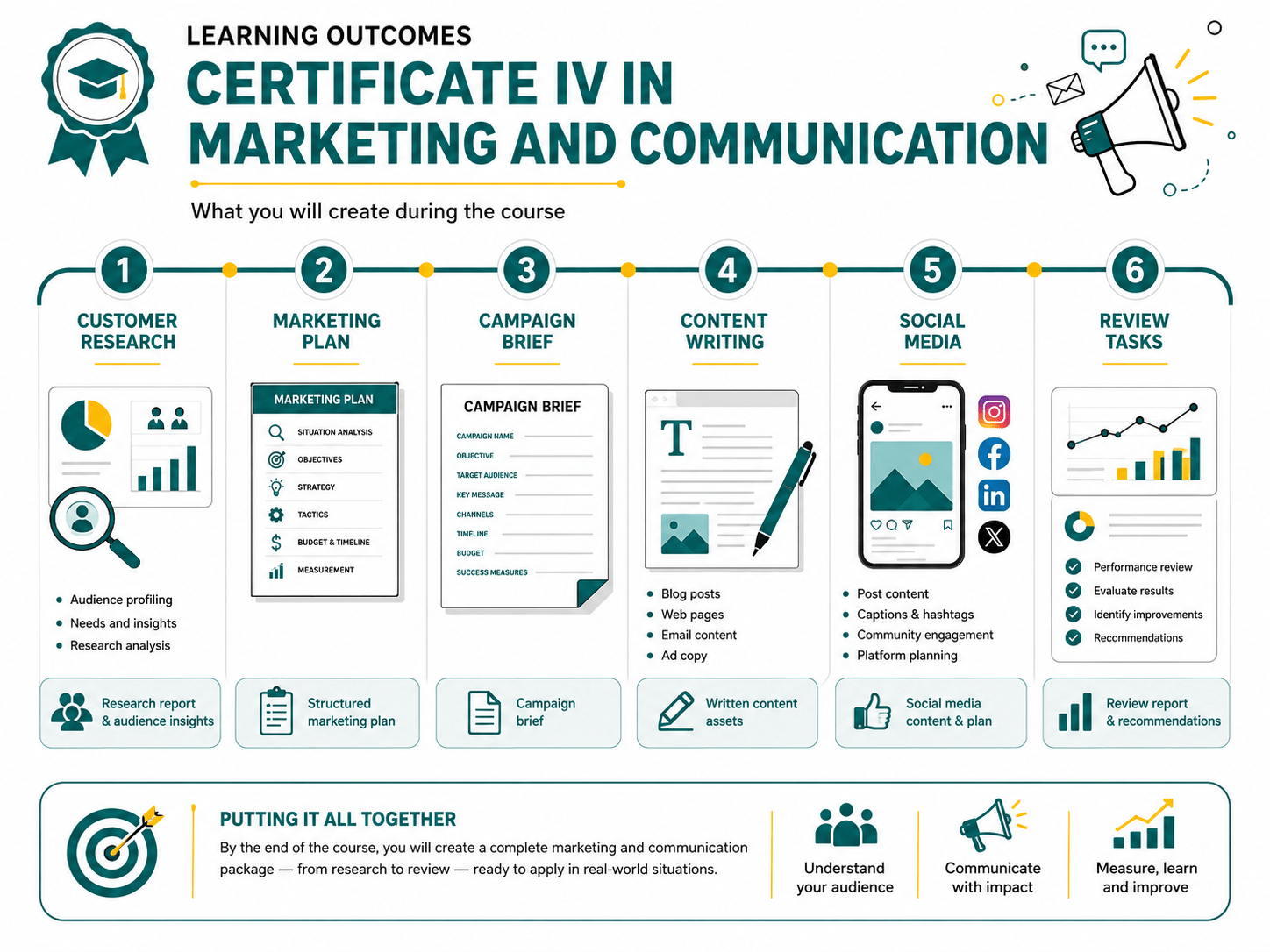
In the Certificate IV in Marketing and Communication (BSB40820) you learn to communicate and present professionally, understand why customers buy, plan campaigns and marketing activities, promote products and services, create digital content and develop a social media strategy. The 12 units run across four stages that follow a real campaign. You learn by producing the work, not by sitting exams, so you finish with a portfolio of marketing assets: customer personas, market research, campaign plans, content calendars, a social media strategy and campaign reports. That portfolio is the point, because it lets you show an employer what you can do rather than only listing what you studied.
Key takeaways
- The course teaches four connected capability areas: communication, customer insight, campaign planning, and digital and social marketing.
- You learn by doing. Each unit produces a real marketing asset rather than an exam answer.
- By the end you hold a portfolio that can include personas, research reports, campaign plans, content calendars, a social media strategy and performance reports.
- There are no timed exams. Assessment is competency-based: you produce work to a standard, and a qualified trainer reviews it.
- The skills are practical and transfer across industries, which is what makes the portfolio useful whatever sector you target.
There are two ways to learn marketing. You can read about campaigns and answer questions on what you read, or you can plan a campaign, write the content and build the strategy, then have someone judge the work. The first gives you a grade. The second gives you something to show. This qualification is built on the second.
On this page
- The four things you learn
- What you build (your portfolio)
- How the work maps to real job tasks
- How assessment works
- Is this the right level for you?
That choice has a name at Vanguard Business Education: Applied Capability Education. You are assessed on demonstrated capability, the marketing work you produce, rather than on recalling definitions. This guide covers what you learn in each of the four stages, the assets you build along the way, and how the assessment actually works. It sits under the complete guide to the Certificate IV in Marketing and Communication.
The four things you learn
The 12 units group into four capability areas that follow a campaign from first idea to live delivery. Each builds on the one before. The full plain-language breakdown sits in the guide on what you learn in the Certificate IV in Marketing and Communication, and the practical marketing skills covered in BSB40820 lists the specific competencies.
| Stage | What you learn | What you build |
|---|---|---|
| 1. Communication foundations | Present ideas, write professional documents, communicate with stakeholders. | Presentations, business and marketing documents |
| 2. Customer insight | Analyse consumer behaviour, understand the industry, think critically. | Customer personas, market research reports |
| 3. Campaign planning | Assess opportunities, plan and coordinate marketing activities. | Campaign plans, marketing activity plans |
| 4. Digital and social | Promote products, create digital content, develop social strategy. | Digital assets, content calendar, social media strategy |
What do you learn in the Certificate IV in Marketing and Communication?
You learn to communicate and present professionally, analyse consumer behaviour and markets, plan campaigns and marketing activities, promote products and services, create digital content and develop a social media strategy. These are delivered across 12 units in four stages that follow a real campaign.
What you build, area by area
Each capability area produces work you keep, and each has a dedicated guide if you want to go deeper on that part of the course. Here is what you create and where to read more.
Marketing content
You write content that holds a reader’s attention and serves a purpose. More on writing marketing content in this course.
Customer and market research
You research who the customer is and what moves them. More on customer and market research.
Marketing plans
You produce real plans, not templates filled in. More on whether you create real marketing plans.
Campaigns and promotions
You plan promotional activity end to end. More on how the course covers campaigns and promotions.
Social media strategy
You build a documented social strategy aligned to objectives. More on how the course teaches social media marketing.
The assessment work
Each task is an asset, not an exam. More on the assessment tasks included.
How the four stages build a portfolio: a worked example
It helps to see how the stages connect, because the design is deliberate. Imagine you work through the course around a single example business, say a small local gym. Each stage produces one connected piece of the whole:
1Communication foundations. You write a clear, professional document introducing the gym’s offer and prepare a short presentation of it.
2Customer insight. You research who the gym’s customers actually are and why they join or leave, and you produce a customer persona and a short market research summary.
3Campaign planning. Using that insight, you plan a real campaign to attract new members, with objectives, audience, activities and a timeline.
4Digital and social. You develop a social media strategy and a content calendar to deliver the campaign online, and you create sample content to promote it.
By the end you do not have four disconnected assignments. You have a connected body of work, a persona, research, a campaign plan, a social strategy and content, all for one business, that reads like the work of someone who can actually run marketing. That is the portfolio, and it is built into how the course is structured rather than added on afterwards.
How the work maps to real job tasks
The portfolio matters because each asset mirrors something a marketing team does in practice. This is the connection between studying and working: the assessment work is not academic exercise, it is the same kind of task a marketing role involves. The table below shows how a few of the assets you build relate to real job tasks.
| Marketing asset you build | Real-world job task it mirrors |
|---|---|
| Customer persona | Briefing a designer or writer on who a campaign is aimed at. |
| Market research summary | Helping a team decide which audience or message to pursue. |
| Campaign plan | Presenting a marketing calendar or activity plan to a manager. |
| Content calendar | Planning a brand’s posts and content over the coming weeks. |
| Social media strategy | Setting the content direction for a brand’s social channels. |
| Campaign report | Reviewing what worked after a campaign and reporting back. |
None of this guarantees a particular role, since employers also weigh experience and fit, but it shows why the work translates: you are practising the actual tasks of marketing, not just learning about them.
Will I create real marketing work in this course?
Yes. You produce marketing assets as you go, including customer personas, campaign plans, content calendars, a social media strategy and campaign reports. The work is assessed rather than tested through exams, so you finish with a portfolio.
How the assessment actually works
Competency-based assessment is different from an exam, and the difference matters. You are not marked on a percentage. You produce a piece of marketing work, a trainer judges it against the unit requirements, and the result is either competent or not yet competent. Not yet competent is not a fail; it means there is something to address, and you revise and resubmit with feedback. The point is a standard met, not a score scraped. This is a nationally recognised VET qualification (BSB40820), so assessment follows the Australian vocational education and training framework: you are assessed on practical competency against the unit standards rather than on theoretical grades.
Two kinds of support sit behind that. SmartCoach™ is the always-available learning assistance that answers questions and supplies templates at the point you are stuck. A qualified trainer does the human marking and writes the feedback. The AI keeps you moving; the trainer makes the competency decision. Both are included, and the guide on the assessment tasks in the course goes deeper on what each submission involves.
Is this the right level for you?
An honest account of a qualification names its edges:
1It is not a single-platform certification. You learn to plan and run digital and social marketing, but the course is not a deep certification in one ad platform. If a vendor badge in one tool is all you need, get that directly.
2It is not a design or coding course. You create digital content and assets, but this is marketing capability, not graphic design or web development to a specialist level.
3It is foundational, not advanced strategy. You build the capability to support and coordinate campaigns. Owning a full marketing strategy for an organisation is Diploma-level and beyond.
Are there exams in the Certificate IV in Marketing and Communication?
No. Assessment is portfolio and activity based. You demonstrate competency by producing marketing work to a required standard, which a qualified trainer reviews and gives feedback on.
Build a marketing portfolio as you learn
The Certificate IV in Marketing and Communication (BSB40820) is delivered 100% online by Vanguard Business Education, with no entry requirements and a SmartCoach™ supporting you from your first unit. You produce real marketing work, not exam answers. View the course, or enrol when you are ready. Backed by real trainer and SmartCoach™ support.
Free: the full BSB40820 course guide
See the unit list, the marketing assets you build and how the 100% online training works, sent straight to your inbox.
Sent to your inbox.
Further resources
Learning guides in this cluster
- What you learn
- Practical skills covered
- Creating real marketing plans
- Campaigns and promotions
- Writing marketing content
- Customer and market research
- Social media marketing
- Assessment tasks included
Start here
Vanguard Business Education | RTO 91219 | Established 2006 | Nationally recognised training
Version 1.1, 25/06/2026
BSB40820 Certificate IV in Marketing and Communication: 100% online, no entry requirements, real trainer and SmartCoach™ support.
View Course