
Read more about the article hidden-cost-of-learning-that-stops-at-participation
A completed training environment can appear orderly, while unresolved work and rework emerge later in the workplace.

hidden-cost-of-learning-that-stops-at-participation

The Hidden Cost of Learning That Stops at Participation Learning Activity vs Real Capability Quick Answer Learning that stops at participation appears efficient, but it creates hidden costs. When engagement…

Continue Readinghidden-cost-of-learning-that-stops-at-participation
Read more about the article learning-activity-vs-real-capability
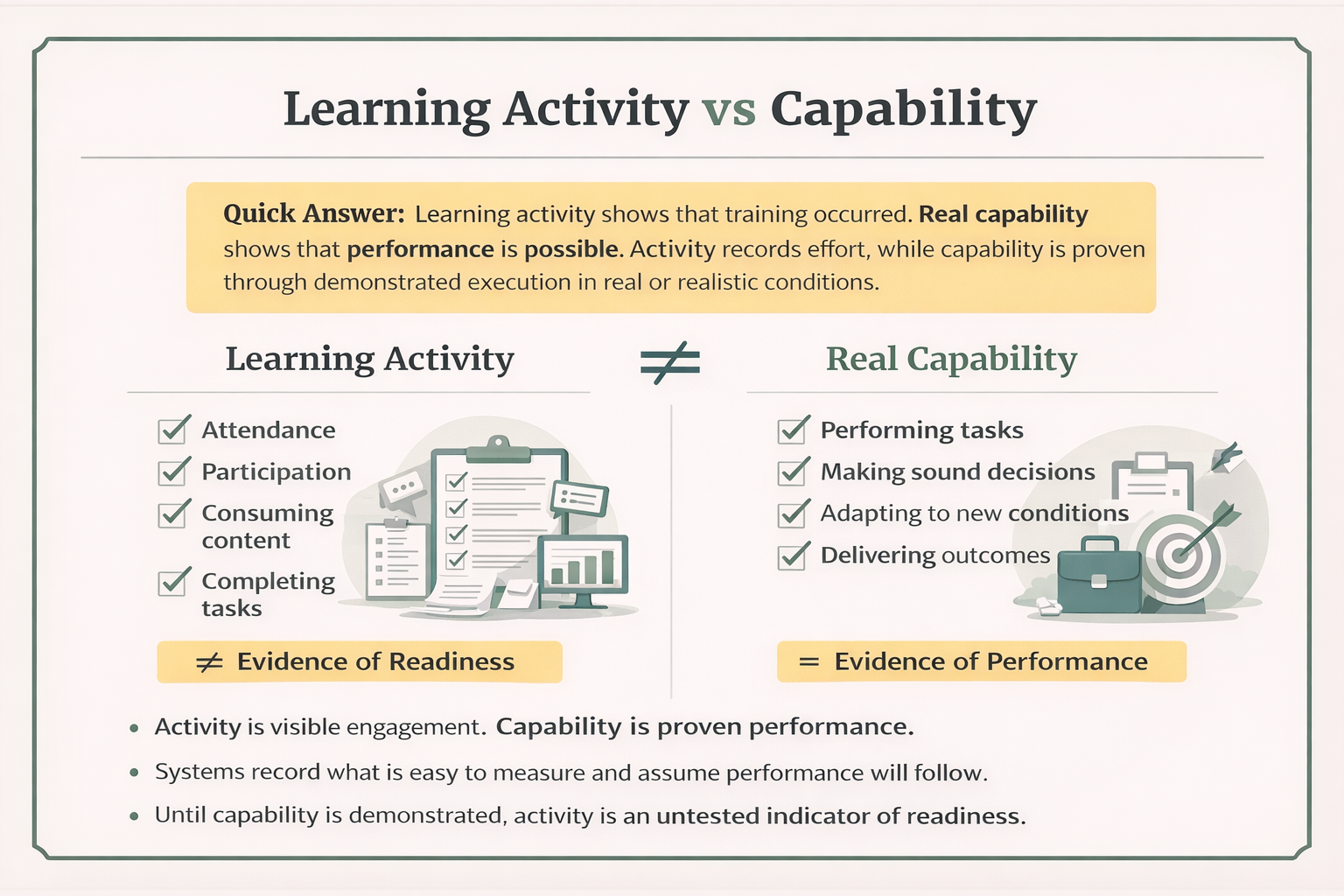
Learning activity shows engagement. Real capability is proven through demonstrated performance.

learning-activity-vs-real-capability

The Difference Between Learning Activity and Real Capability   Learning Activity vs Real Capability Quick Answer: Learning activity shows that training occurred. Real capability shows that performance is possible. Activity…

Continue Readinglearning-activity-vs-real-capability
Read more about the article checkbox-learning-problem-completion-doesnt-equal-capability
A completed checklist signals progress, but does not verify real capability or performance.

checkbox-learning-problem-completion-doesnt-equal-capability

The Checkbox Learning Problem: Why Completion Doesn’t Equal Capability Why Completion Does Not Equal Capability Quick Answer: Completion does not equal capability because checklists measure activity, not performance. When learning…

Continue Readingcheckbox-learning-problem-completion-doesnt-equal-capability
Read more about the article The Difference Between Participation and Performance in Vocational Training
Performance is demonstrated through evidence and judgement, not inferred from attendance or task completion.

The Difference Between Participation and Performance in Vocational Training

The Difference Between Participation and Performance in Vocational Training Quick Answer The distinction between participation and performance is critical because participation shows activity, not readiness. Attendance, submission, and completion indicate…

Continue ReadingThe Difference Between Participation and Performance in Vocational Training
Read more about the article Why Traditional Assessment Fails (And What Applied Capability Does Instead)
Traditional assessment often focuses on written tasks and completion rather than demonstrated workplace capability.

Why Traditional Assessment Fails (And What Applied Capability Does Instead)

Why Traditional Assessment Fails (And What Applied Capability Does Instead)   Quick Answer Traditional assessment models often fall short because they prioritise compliance and completion over demonstrated performance. Developed by…

Continue ReadingWhy Traditional Assessment Fails (And What Applied Capability Does Instead)
Read more about the article The 3 Core Principles of Applied Capability Education
The three core principles of Applied Capability Education shift vocational training from participation based completion to verified workplace capability.

The 3 Core Principles of Applied Capability Education

The 3 Core Principles of Applied Capability Education Quick Answer Applied Capability Education is built on three core principles that ensure vocational training leads to real workplace capability, not just…

Continue ReadingThe 3 Core Principles of Applied Capability Education
Read more about the article Applied Capability Education: Framework and System Architecture
Capability is not assumed through completion. It is demonstrated, evidenced, and confirmed through real or realistic performance.

Applied Capability Education: Framework and System Architecture

Applied Capability Education: The Complete Framework for Outcome-Focused Training Applied Capability Education Quick Answer Applied Capability Education is an outcome driven approach to vocational training aligned with the 2025 RTO…

Continue ReadingApplied Capability Education: Framework and System Architecture